When a buyer or seller opens ChatGPT and types "Who are the best real estate agents in Boise?" — where does the answer come from?
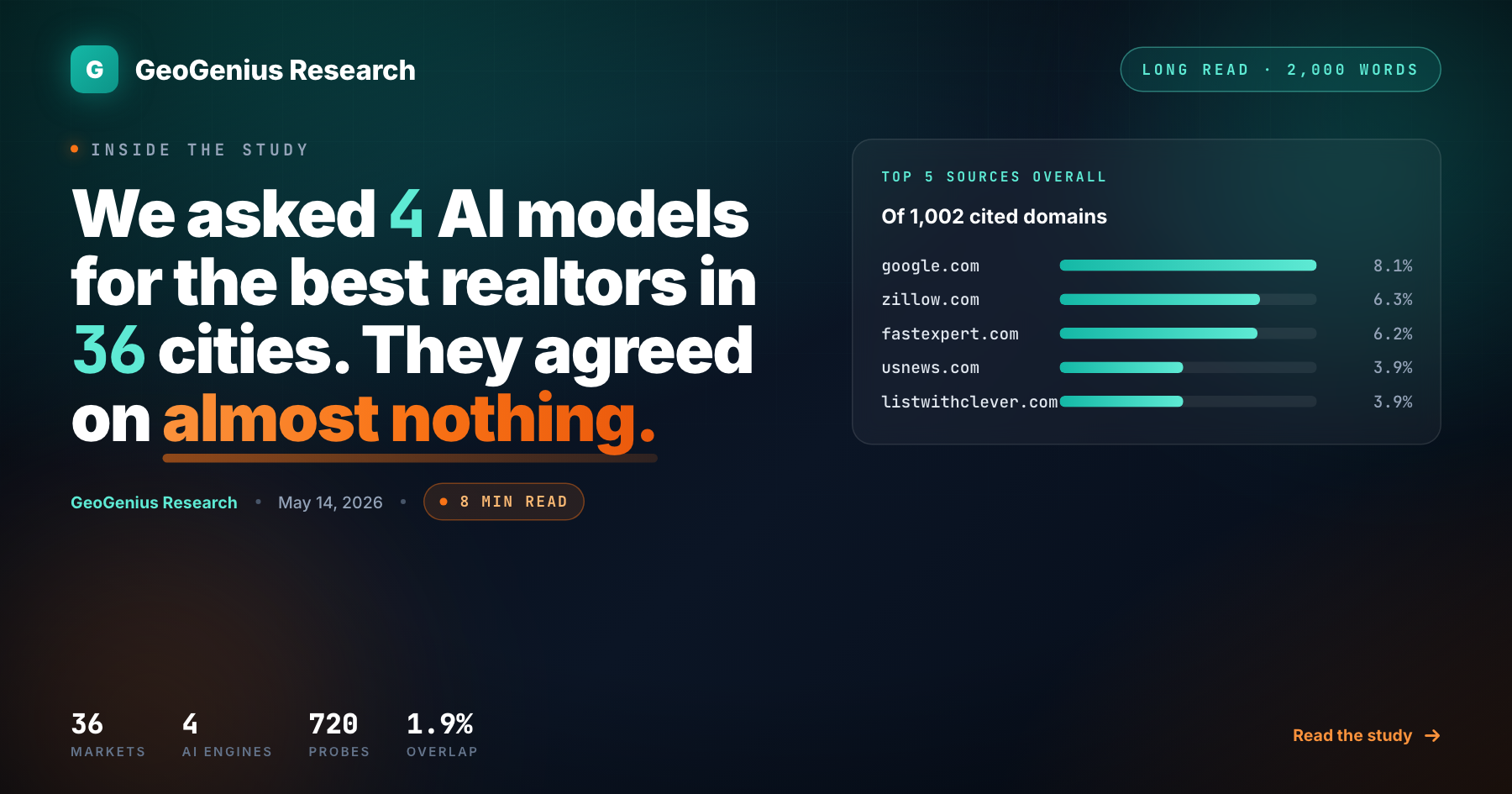
For the last three weeks, we ran a controlled experiment to find out. We probed four leading AI assistants — ChatGPT, Grok, Google AI (Gemini), and Claude — across 36 metropolitan markets of varying density and region, using 5 standardized buyer- and seller-intent queries per market. The result: 720 probes, 4,455 citations, and 1,002 unique source domains.
The headline finding can be stated in one sentence: The four AI engines almost never recommend agents using the same source pool. Only 1.9% of the cited domains appear across all four models. That has enormous implications for any agent, brokerage, or marketer who thinks of "AI visibility" as a single problem with a single solution.
This report is the long version. We're publishing the methodology, the raw findings, the surprising patterns, and the practical playbook below.
See the interactive dashboard with all 36 markets →
Why we ran this study
A growing share of real-estate buyers and sellers — recent research puts the number above 40% — are now turning to AI chat assistants as their first stop. Yet most agent marketing strategies still treat "search" as a single channel dominated by Google. They optimize their Zillow profile, build a website, and assume that's enough.
It isn't. Each AI engine maintains its own retrieval pipeline. ChatGPT's web search is built on a different stack than Gemini's. Claude's web_search reads different sources than Grok's. The "open web" looks very different from inside each model. We wanted to map that variation precisely.
Methodology
The market sample. We selected 36 U.S. metropolitan and micropolitan markets stratified across three density tiers (12 each):
- Major Urban (Tier 1): New York, Boston, Philadelphia, Miami, Atlanta, Dallas, Chicago, Minneapolis, Detroit, Los Angeles, Seattle, Phoenix
- Mid-Size / Suburban (Tier 2): Pittsburgh, Hartford, Richmond, Nashville, Charlotte, Tampa, Indianapolis, Columbus, Kansas City, Denver, Portland (OR), Sacramento
- Small / Rural-Adjacent (Tier 3): Burlington (VT), Portland (ME), Scranton, Savannah, Pensacola, Shreveport, Des Moines, Sioux Falls, Fargo, Boise, Spokane, Santa Fe
The sample is balanced across four U.S. regions (Northeast, South, Midwest, West) so we can detect both density and regional effects.
The query set. For every market, we asked five standardized natural-language questions:
- "Who are the best real estate agents in {city}, {state}?" (generic)
- "Who should I hire to sell my home in {city}, {state}?" (seller-intent)
- "Best realtor to help me buy a house in {city}, {state}" (buyer-intent)
- "Top luxury real estate agents in {city}, {state}" (specialty)
- "Find a real estate agent near {city}, {state}" (local-search)
The engines. We hit each model's official live-search API:
- ChatGPT: OpenAI Responses API with
web_searchtool, modelgpt-4o - Grok: xAI Responses API with
web_searchtool, modelgrok-4-fast-non-reasoning - Google AI: Vertex AI Gemini API with Google Search grounding, model
gemini-2.5-flash - Claude: Anthropic Messages API with
web_searchtool, modelclaude-sonnet-4
We captured, for every probe, the full response text, the list of citation URLs the model attached, the search queries each engine executed internally, and the latency. Every citation URL was normalized to its registrable domain (e.g., zillow.com) so we could compare apples to apples.
We deduplicated probes to a clean 720 (36 markets × 5 queries × 4 engines), giving us 180 probes per engine, 60 per engine×tier cell, and 45 per engine×region cell — well above the threshold for stable proportion comparisons.
Finding 1: The AI engines barely overlap
Out of 1,002 unique source domains cited across the entire study, only 19 (1.9%) were cited by all four engines. Another 40 domains were exclusive to a single engine (10 per engine).
The 19 "universal" domains tell us what the AI ecosystem has organically converged on:
- Aggregators (3): zillow.com, redfin.com, compass.com
- Local media (1): chicagomag.com
- Individual agent or team websites (15): the rest
Notice what is not on that list. Realtor.com. Yelp. FastExpert. HomeLight. US News & World Report Real Estate. RateMyAgent. Expertise.com. Every one of those is a top-10 source for at least one AI engine — but none of them are cited by all four. If your "AI visibility plan" is built around any of those platforms, you are optimizing for one quarter of the AI search market.
Finding 2: Each AI engine has its own personality
When you aggregate the citations by engine, four distinct profiles emerge.
ChatGPT — The Citation Outsourcer
ChatGPT's single most-cited source is google.com, at a striking 37.7% of all its citations. The next most-cited sources are city government websites (cityoffargo.com, spokanecity.org, charmeck.org). In effect, ChatGPT does a Google search and then cites the search results page rather than the underlying authoritative content.
Its concentration index (HHI = 1,436) is roughly 4× more concentrated than the other engines, which means ChatGPT relies on a very narrow set of go-to sources to construct most of its real-estate answers.
Grok — The Broad Researcher
Grok is the most prolific engine, averaging 8.6 citations per probe — more than any competitor. Its top sources are evenly distributed: zillow.com (9.5%), realestate.usnews.com (7.4%), yelp.com (6.7%), realtor.com (6.1%), fastexpert.com (6.0%). No single source dominates. Grok is also the only engine that meaningfully cites social media (Facebook, Instagram) and trade publications for real estate research.
Google AI (Gemini) — The Aggregator Loyalist
Gemini's top source is fastexpert.com (11.4%) — the only engine to lean this hard on FastExpert. It then cycles through zillow.com, listwithclever.com, realtrends.com, and homelight.com. Gemini cites Reddit and BiggerPockets more than any other model, suggesting it leans on community-discussion content as a signal of agent reputation.
Claude — The Editorial Purist
Claude favors editorial and review-driven sources: realestate.usnews.com (10.4%), yelp.com (9.9%), homelight.com (6.7%), and expertise.com (5.4%). It is the only engine that meaningfully cites trade publications like The Real Deal and HousingWire. Claude's success rate (49% of probes returned results in our study) was lower than the other engines, but that is an artifact of our own API provisioning during the run rather than anything about Claude: 84 of its 92 failed probes returned an account credit-balance error and 7 more hit a rate limit. On the probes it did complete, Claude returned citations 87 of 88 times. The practical caveat is that its citation pool (556) is smaller than the others', so its shares carry wider error bars — but the citations it does return are highly editorial in character.
Finding 3: The "Rural AI tax"
Density matters more than we expected.
Across all four engines combined, google.com accounts for 9.9% of citations in rural markets versus only 6.1% in urban markets. The contrast is even starker when you isolate ChatGPT, where the Google share goes from 33% in urban markets to 45% in rural markets.
Why? Local content gets thinner as you move down the density ladder. In a major metro, the AI has access to dozens of local newspapers, brokerage blogs, agent websites, and review platforms. In a small market, that long tail collapses, and the AI falls back on a smaller list of trusted national sources.
For rural and small-market agents, the implication is direct: you are competing against a much smaller universe of sources, which means a single well-optimized profile on Zillow, FastExpert, or a strong personal website can move the needle far more than it would in a saturated urban market.
Finding 4: Three of four engines are remarkably tier-stable
If you isolate each engine's top citation by density tier, an interesting pattern emerges:
| Density | ChatGPT | Grok | Google AI | Claude |
|---|---|---|---|---|
| Urban | google.com (33%) | US News (9%) | FastExpert (10%) | US News (12%) |
| Suburban | google.com (34%) | Zillow (9%) | FastExpert (11%) | Yelp (11%) |
| Rural | google.com (45%) | Zillow (12%) | FastExpert (13%) | Yelp (10%) |
Three of four engines stay loyal to the same top source regardless of market size. Only ChatGPT swings dramatically. That's a useful piece of intelligence: optimizing for Grok, Gemini, and Claude can be done at the national level with very predictable returns. Optimizing for ChatGPT requires a market-specific strategy.
Finding 5: Regional variation is real but smaller than density variation
The four U.S. regions show modest variation:
- Northeast is the most Google-heavy region (11.3% of all citations) — likely because of dense local-news coverage that Google indexes well
- South is the most balanced — no single source dominates
- West rewards Yelp more than other regions (3.8% share)
- Midwest is unusually friendly to Realtor.com (4.3% — the highest of any region)
In practice, the regional differences are about half the magnitude of the tier differences. Density is the bigger lever.
What this means for real-estate agents
If you take only one action from this report, here is the action that maps directly to the data:
Optimize across all four "universal" aggregator domains: Zillow, Redfin, and Compass. Those are the only platforms cited by every AI engine. Everything else is engine-specific.
Beyond that, here are the practical implications, by engine:
- For ChatGPT visibility: your Google search result for "your name + city" must be excellent. ChatGPT cites Google more than any other source. That means strong Google Business Profile, owned-domain authority, and structured data.
- For Grok visibility: broad coverage. Get on Zillow, US News Real Estate, Yelp, Realtor.com, FastExpert. Grok pulls from all of them. Social presence helps disproportionately.
- For Google AI visibility: FastExpert is the single largest lever. Reddit and BiggerPockets matter — community engagement is a measured signal.
- For Claude visibility: editorial content is the lever. Get featured on US News Real Estate, HomeLight Top Agents, Expertise.com. Trade-publication mentions (The Real Deal, HousingWire) are exclusively cited by Claude.
The biggest mindset shift: stop thinking about AI visibility as one channel. It is at least four overlapping channels, each with its own preferred sources, each with its own ranking signals, each requiring a slightly different strategy.
What's next
This study is a first cut. We're already planning a follow-up that will:
- Re-probe quarterly to detect shifts as the models update their training and retrieval pipelines
- Expand to 100+ markets to support city-level statistical claims
- Add structured-data analysis — what schema markup do the cited pages have in common?
- Test response prompts (e.g., adding "with citations" or "list specific agent websites") to see how it changes the source mix
If you'd like to be notified when the next study drops, sign up for free and we'll send it to you.
If you'd like to see where you personally rank across all four engines, check your AI visibility score — it's free, takes 30 seconds, and you'll see your current citations across ChatGPT, Grok, Gemini, and Claude.
Reference materials
- Interactive dashboard: /ai-report — explore the data by market, engine, tier, and region
- Raw data (CSV): Probes and citations available on request — email research@geogenius.ai
- Methodology repo: Available to journalists and researchers; please request access
GeoGenius is the AI visibility platform built for real estate professionals. We measure where you rank across every AI engine and give you a step-by-step plan to improve. Get your free score →